
Why Spreadsheets No Longer Cut it for Road Capital Maintenance
Key Takeaways
- Spreadsheets cannot cope with the complexity, scale, and scrutiny of modern road capital maintenance decisions.
- Long-term, defensible investment planning requires tools that model deterioration, risk, and funding trade-offs across networks.
- Asset Investment Planning software enables clear justification, stronger auditability, and better outcomes for every pound invested.
For years, spreadsheets have been the backbone of road maintenance planning across UK councils. They’re familiar, flexible and inexpensive. But as pressures on local highways intensify (aging assets, tighter budgets, increased scrutiny and higher public expectations) spreadsheets are increasingly showing their limits. When it comes to making robust, defensible capital maintenance decisions, they’re no longer enough.
The growing complexity of highway decisions
Modern highway asset management is not just about resurfacing the worst roads one year at a time. Councils must balance condition, safety, risk, whole-life cost, carbon impact, funding constraints and political priorities, often across thousands of assets and many years. Add the need to align with the DfT Transparency Report expectations and audit requirements, and the decision landscape becomes highly complex.
Spreadsheets struggle in this environment. As datasets grow, they become harder to manage, more error-prone and increasingly dependent on individual officers who “know how it works”. Version control issues, broken formulas and manual workarounds can undermine confidence in the outputs, particularly when plans are challenged by auditors, members or the public.
Why spreadsheets fall short
Spreadsheets are essentially static calculation tools. They can store data and perform maths, but they don’t understand the network. They lack built-in asset deterioration models to enable a long-term view instead reacting one year at a time. They lack risk frameworks or optimisation logic. Scenario testing, such as comparing funding levels or intervention strategies, often requires copying sheets and manually reworking assumptions, which is time-consuming and opaque.
Perhaps most importantly, spreadsheets make it hard to explain why a programme is optimal. When decisions need to be justified, the audit trail is often weak. For example, why one road is funded over another, or how a programme minimises long-term backlog.
The case for Asset Investment Planning tools
Asset investment planning tools like Brightly’s Predictor are purpose-built for asset management and go beyond data storage. They combine condition data, deterioration models, treatment rules and funding constraints to generate optimised, evidence-based programmes that consider multiple years.
Key benefits include:
- Better investment decisions: Tools such as Predictor can optimise across the entire network and different asset classes, targeting treatments that deliver the greatest long-term value, reduce risk and slow asset decline, rather than simply reacting to worst-first conditions.
See the future, now: By having the ability to look many years into the future, decision makers can foresee the outcomes of today’s decisions. What is the long-term impact of that budget cut? Will revenue spending increases as result and wipe out any savings?
Another benefit of analysing over the longer term is that you can get early warning of, and plan for, budget shock, including when many assets fall into poor condition at the same time and the investment required to keep them serviceable exceeds the available budget.
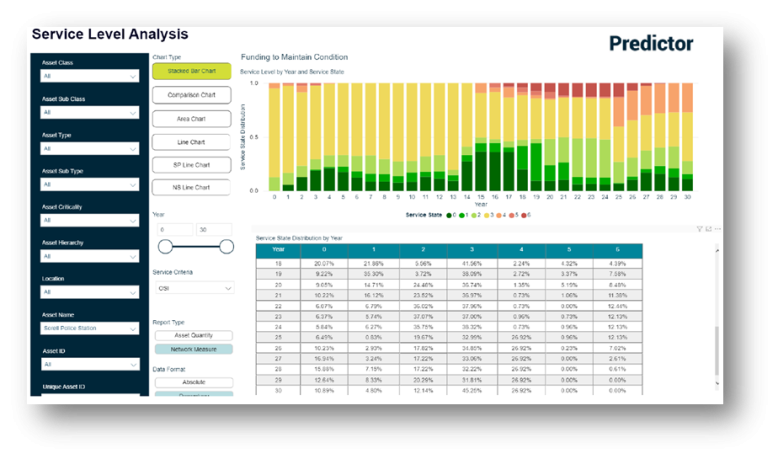
1. Brightly’s Predictor visualises future service levels, helping councils understand the long-term impact of today’s funding choices.
- Transparent, auditable outputs: Assumptions, rules and methodologies are clearly defined and repeatable. This supports scrutiny from internal audit, external reviewers and elected members.
- Scenario planning at speed: Councils can quickly test “what if” scenarios without rebuilding spreadsheets from scratch. For example, tests of different budgets, policy priorities, carbon reduction goals or intervention strategies.
- Consistency and resilience: Knowledge becomes embedded in the system, not in a single officer’s spreadsheet. This reduces the loss of critical information and supports continuity during staff changes.
Spreadsheets still have a role, but not the lead one
This isn’t about abandoning spreadsheets entirely. They remain useful for ad-hoc analysis, data exploration and local reporting. But relying on them as the primary engine for multi-million-pound capital maintenance decisions is increasingly risky.
As councils face tougher funding choices and greater demands for transparency, Asset Investment Planning tools like Brightly’s Predictor provide a more robust, defensible and future-proof approach. In a world where every pound must work harder, better decisions aren’t a luxury, they’re essential.
If your capital maintenance decisions need to stand up to scrutiny, future funding pressures and rising expectations, it may be time to move beyond spreadsheets. Discover how Brightly’s Predictor helps councils build transparent, optimised and long-term road investment programmes grounded in evidence and built to stand up to scrutiny.

