
What If... Your Assets Are Failing More Than You Planned For?
Part 1 of our “What If...” series on smarter asset maintenance
What if an asset you own starts requiring frequent repairs, but your CMMS can’t tell you the conditions surrounding each failure? What if the most important moment in your asset maintenance program isn’t when equipment breaks, but in the months or even years leading up to it?
The costliest problem for many maintenance teams isn’t the failure itself. It’s often the lack of clarity around why the failure happened in the first place.
Our new e-book What If... A Guide on How to Ensure Your Asset Maintenance Strategy is Effective at Every Lifecycle Stage helps enhance your maintenance strategy by enabling you to take full advantage of modern CMMS or EAM capabilities. By tracking and connecting complete asset data, your CMMS can “do the talking” for you to correct issues causing you trouble, inform capital planning, and maximize productivity during every phase.
Seeing the full story behind asset failures
The value of your CMMS should increase as your assets age. But that can only happen when your data is captured early and maintained consistently over time. Without clear visibility into performance patterns, facilities maintenance leaders must rely on disconnected events and guesswork instead of hard evidence to gain support when it matters most.
In the 2026 Asset Lifecycle Report, 82% of asset and facilities leaders say their organization can predict failures before they occur, but only 22% said that reactive repairs are still a large portion of total work orders.
When your CMMS can report accurately on repair frequency, cost trends, and the history around each failure, you can make more informed decisions about preventive maintenance, repair vs. replacement, and budgetary needs before the issue becomes urgent.
Asking the right questions
Developing your asset management program means understanding the full lifecycle of your assets, from when they’re new and predictable, to when they’re moving into recognizable patterns, and eventually when they are aging and even the smallest oversights can become costly problems.
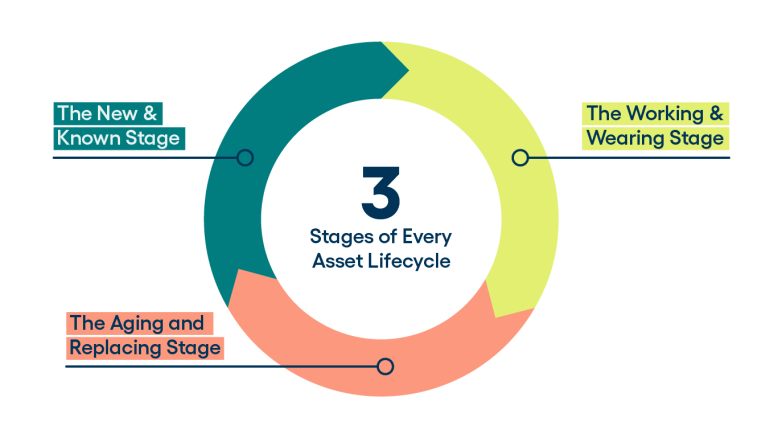
Identifying the key challenges, opportunities, and strategic focus during equipment performance phases can ensure your CMMS adds value from the moment it’s implemented. Begin by asking these questions for each of the three asset stages:
- What are the biggest challenges at this stage? Depending on the asset phase, many teams can put off asset tracking, miss early signs of decline, and fail to prepare leadership for upcoming budget requests.
- What are the biggest risks at this stage? Typical pitfalls can include losing track of crucial asset information, not relying on trend data, and being forced into reactive repairs that cause disruptions.
- What does success look like at this stage? Accurately recording every asset in a CMMS, having clear visibility into asset history and patterns, and careful budgeting and capital planning should take precedence across asset lifecycles.
- What does this stage set up for the future? By optimizing each asset phase, teams can build reliable data throughout the asset’s life, achieve better repair or replacement decisions and preventive maintenance, and foster leadership support for budgeting and capital planning.
Conclusion
When asset performance doesn’t go as expected, a powerful CMMS can be leveraged to anticipate and address “what-ifs” before they escalate into major problems. A modern CMMS should be able to pinpoint when failures are isolated or recurring, how failures align to different factors, and if costs begin to trend upward. Building this strong data foundation is possible only if complete and accurate asset history is documented from day one.
For tips on how to strengthen your CMMS or EAM solution to stay ahead of failures, improve capital planning, and build an intentional asset strategy for long-term success, download our new “What If..." Guide to Ensuring Your Asset Maintenance Strategy is Effective at Every Lifecycle Stage.


