

Background
The facilities team at Loyola University New Orleans, like many in higher education, contends with tightened budgets, aging infrastructure, and inherent operational risks.
In 2025, the university’s infrastructure, particularly its aging boilers and chillers, was operating beyond its useful life, compounded by a lack of standardized preventative maintenance and the corrosive effects of New Orleans’ hard water. This combination created a high-risk environment, ultimately leading to a critical infrastructure failure.
Under the leadership of Director of Facilities, Kyle Gregore, the crisis became a pivotal moment, catalyzing a comprehensive transformation in capital planning and long-range operational resilience, significantly aided by Brightly Asset Essentials.
New Director of Facilities, New Ways of Working
Gregore brought more than 20 years of experience as a Senior Master Sergeant with the Air National Guard to Loyola University. His background included serving as a national trainer for their work order and asset management systems, giving him direct insight into facilities management. Gregore stated, “I knew the capabilities and the potential of a work order system, especially an electronic work order system.” He also understood the pitfalls of disconnected systems, noting that the Air Force’s work order and asset management were not integrated.
Upon arriving at Loyola in January 2024, Gregore quickly identified areas for improvement. He observed, “Prior to me coming to Loyola, things were done differently... preventative maintenance was not something that was on the forefront of everybody’s mind.” The previous system at Loyola was antiquated. He presented his finds to the former COO, advocating for an electronic work order system to provide visibility and improve communication with employees.
After issuing an RFP, Gregore discovered Brightly. Following discussions with Brightly and exploring their offerings, he determined that Brightly’s solutions were “going to hit all the areas that [he] needs for a work order system — categorization, purchase orders, inventories, ability to communicate, ability to track time, etc.”
Brightly’s implementation began with the work order system, followed by the asset management component. This aligned perfectly with Gregore’s long-term vision for the campus: “to have an asset management program that oversees everything... some sort of bridge between it that can then create work orders off of it and then tie into the actual automation software.”
Crisis reveals flaws and the need for an asset management strategy
Thirteen months into Gregore’s role as the Facilities Director, he implemented Asset Essentials and began to develop an overarching asset management strategy. Then the crisis occurred, making the need for a robust asset management strategy at Loyola University New Orleans starkly apparent.
Four days before Mardi Gras in 2025, Loyola’s main boiler and its backup boiler failed due to New Orleans’ hard water. The boiler failures prevented the provision of hot water and air conditioned housing for students across campus during the busiest and coldest time of the year.
Gregore recounted the harrowing events: “I had a boiler tube rupture at about eleven o’clock at night on our main boiler for our campus. Then four hours later, we had another failure on our backup boiler. A four-foot flame ejected out the back of the blower motor and essentially rendered us completely useless at heating our campus.” The repercussions were immediate and far-reaching.
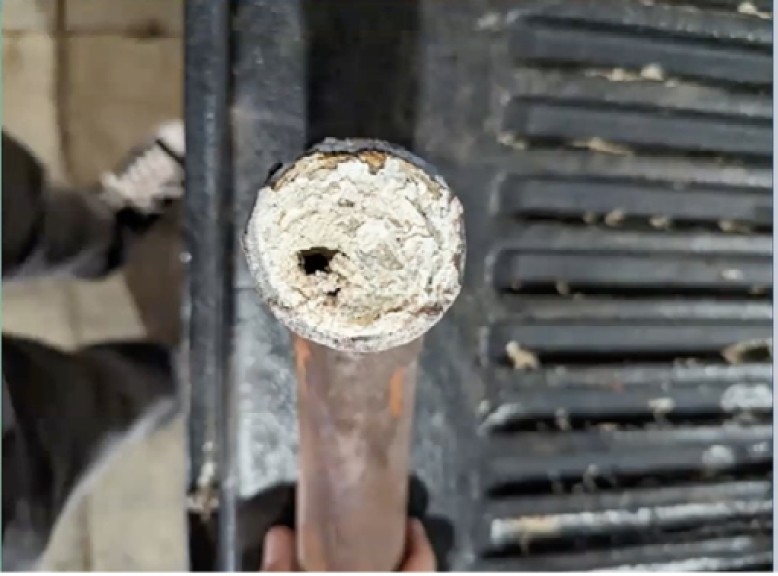
Figure 1: The ruptured boiler tube, filled with calcium deposits.
Gregore identified the root cause as twofold: the age of equipment and the maintenance.
“We weren’t tracking PMs,” Gregore stated. “Nothing was standardized. We didn’t have service contracts in place.” A vivid image of a ruptured boiler tube, calcified with calcium deposits, graphically illustrated the consequences of neglected water treatment and maintenance. Gregore explained: “This little hole that you see in there, that’s all the path that the water could take. So, what happens when you start heating up water? It starts to expand, and it’s gotta go somewhere.”
Gregore embraced the philosophy that “every obstacle is an opportunity for improvement.”
The immediate response to the crisis involved securing rental boilers and initiating a long process to solve the issue, which ultimately took about ten months before Gregore was able to bring the new boiler systems online.
The timing of the Asset Essentials implementation proved fortuitous, as asset data gathering had commenced before the boiler failure, which worked in Gregore’s favor. His prior experience in asset management from his military career informed his realization that such a system needed to be in place. An initial Facilities Condition Assessment (FCA) provided a crucial baseline of their assets.
Loyola’s transformation involved a multi-pronged strategy, addressing both the immediate crisis and longterm prevention. A crucial step was the implementation of Brightly Asset Essentials, an asset management system that reduces maintenance costs, enhances productivity, and supports smarter operational decisions.
With Asset Essentials, Loyola transitioned from a reactive to a proactive maintenance approach. Gregore noted, “We put everything into the system. It’s now generating these work orders ... We’re shifting from being a crisis response team to a preventative maintenance workforce.” This system enables dynamic adjustments to asset lifespans based on real-time maintenance records and external contractor reports, leading to more accurate budgeting and strategic capital planning.
Implementation and Impact: A Crawl, Walk, Run Approach
Loyola adopted a “crawl, walk, run” strategy for implementation, acknowledging that their team, with an average age of 52, needed time to adapt from manual to electronic systems. While all assets are inventoried and PMs are being initiated, linking work orders directly to assets is still a developing. Gregore noted, “We’re using, I would say, probably about 85% of it.” Full work order data has been tracked since August 2024, showing a gradual integration of PMs.
A key to the successful adoption has been Corrin Roach, the office manager/assistant director, whom Gregore credits as the “champion of this program.” She facilitates the transition, allowing technicians to use iPads, phones, paper, or computers based on their comfort level. This flexibility, combined with empowering shop leads with administrator rights, has fostered a sense of ownership. “They’ve went from a culture of waiting to be told what to do and now controlling their own outcomes,” Gregore observed, which “has decreased our downtime immensely.”
The facilities department comprises 27 people, an “extremely undersized department.” It includes four direct reports: an office manager, director of construction, director of mechanical systems and director of operations.
Beyond the Boiler Room: Broader Operational Improvements
The implementation of Brightly Asset Essentials has brought broader benefits. Gregore highlighted its role providing documentation that can resolve miscommunications, particularly with student housing. He explained, “It shows efficiency on our end, and it clears up miscommunication, but it shows inefficiency and miscommunication in other departments.” This transparency has led to new initiatives, including a curriculum for incoming students on basic life skills and proper facility use, addressing issues identified through work order analysis. An upcoming integration will streamline work order submissions from ResLife directly into Asset Essentials, removing human error from the initial process.
The boiler crisis also highlighted the importance of stakeholder communication. Gregore, with a direct line to the university president, emphasized a team effort involving the marketing and communication team, emergency management team, and media relations team.
Beyond Asset Essentials, Loyola is also exploring Asset Investment Planning (AIP) software, which integrates financial data with facilities data. This advanced tool generates predictive budgets, risk scores, and various capital planning scenarios, enabling the university to make accurate budget requests. The university has also realized significant financial benefits, with almost 20% of utility usage saved since January 2024, partly attributable to programs like the Energy Smart program, which provides cash rebates for saving funds.
Leadership and Future Vision
Gregore’s leadership philosophy, shaped by experiences from Hurricane Katrina to overseas deployments, centers on the idea that “the physical place you put somebody in is going to dictate their mental headspace.” He believes in investing in the environment and the people who maintain it, a principle that led to pay raises for janitorial staff and relocating them from a basement office to a prominent building. This has resulted in phenomenal quality of work and near-zero turnover across his teams.
Looking ahead, Gregore is focused on establishing clear parameters for writing directives and policies. Having managed $155 million in capital construction and rebuilt the central plant while constructing a $96 million dorm, his current goal is empowering his team.
Loyola University New Orleans’ journey serves as a powerful testament to how significant failures can be transformed into opportunities for profound improvement. By embracing integrated asset data, predictive modeling, and lifecycle planning through Brightly Asset Essentials, they have successfully built a more resilient, future-ready campus. The ultimate outcome is a robust business continuity plan and a university better equipped to navigate future challenges.